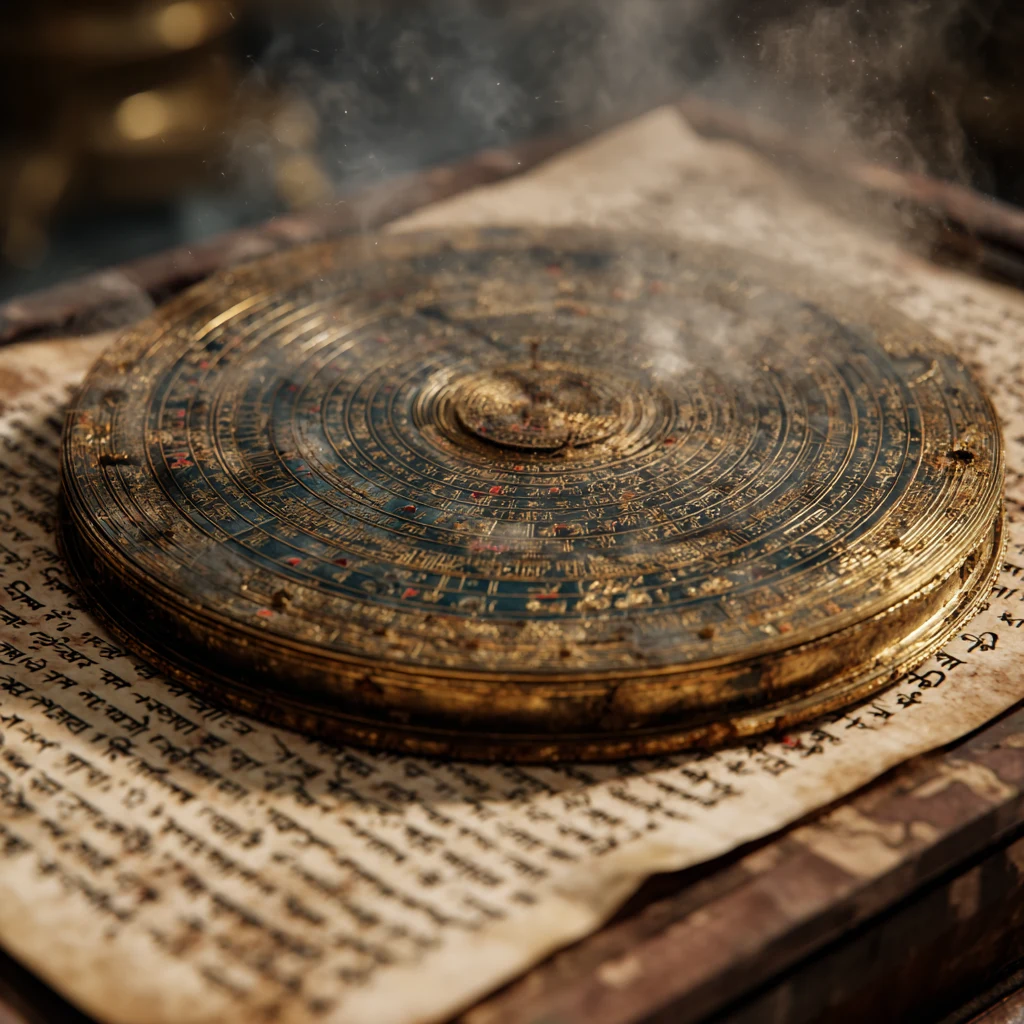
Born from the Vedas
The Vedas, about 5,000 years old, are the oldest body of knowledge known to humanity — perceived by ancient seers who could read the fundamental patterns of existence.
Astrology, or Jyotish in Sanskrit, meaning "the science of light", is one of the six essential limbs of Vedic knowledge. The system was crystallised through the works of Sage Parashara and later refined by Varahamihira — texts that remain the cornerstone of Vedic astrology to this day.
Deeper and different
The most critical distinction: Vedic astrology uses a sidereal framework, tracking planets against the actual fixed stars, not the shifting tropical zodiac used in the West. Over time, this gap has grown to nearly 24 degrees — enough to change the interpretation of an entire chart.
It also developed tools of remarkable precision: Dashas, planetary period systems that map the unfolding of life in timed sequences; Nakshatras, 27 lunar mansions that divide the sky into intimate segments, each with its own character; and Divisional Charts, sub-charts that illuminate specific dimensions of life.
The astronomical foundations
The science rests on centuries of advanced mathematics and astronomy. As early as the 5th century, Aryabhata calculated planetary movements, proposed that the Earth rotates on its axis, and determined the length of the solar year accurate to seven decimal places. A century later, Brahmagupta formally defined zero and described gravity as an attractive force. These scholars laid the numerical foundations that Vedic astrology still relies on today.
— Himal · Founder, Nova